How the Dairy Industry is Ditching Single-Use plastic
The Hidden Plastic Behind Every Coffee
When people think about plastic waste in hospitality, they often picture takeaway coffee cups, straws or food packaging. But one of the industry’s biggest sources of single-use plastic is rarely seen by customers.
Every day, milk arrives through the back door in disposable bottles or cartons, ready to be unpacked, emptied and discarded before the first coffee is even served.
The Udder Way was created to disrupt an outdated dairy supply chain by combining reusable packaging with digital traceability. Working with specialty dairies across five countries and hospitality leaders including Melbourne’s 1 Hotel, Sydney’s JP Morgan, New Zealand’s Hill House Cafe, London’s Google offices and National Specialty Roaster partners like Padre, The Udder Way has reimagined how milk moves through the supply chain. Together, these partnerships are proving that by redesigning the system—not just the packaging—businesses can eliminate plastic waste before it’s ever created.
Rethinking How Milk Moves Through Hospitality
For years, the hospitality industry has worked hard to reduce visible plastic waste, from removing straws to replacing takeaway packaging. Yet one waste stream has remained largely untouched—milk packaging.
Across Australia, more than one billion single-use milk containers are produced every year. While most are recycled, they still need to be manufactured, transported and processed after just one use.
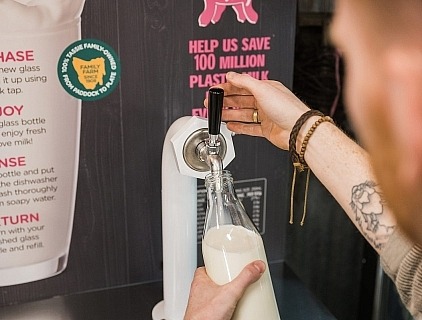
The Udder Way was founded to challenge this linear model by replacing disposable milk packaging with a circular system that combines reusable kegs with bespoke digital technology. Rather than creating waste after a single delivery, the same keg can remain in circulation for years- moving between dairies and customers as part of a closed-loop supply chain.
At the heart of the system is The Udder Way’s proprietary software platform, which provides complete visibility over every keg throughout its lifecycle. Each keg is digitally tracked from filling at the dairy, through to delivery and customer use, to collection, washing, sanitisation and refilling. This allows dairies and hospitality partners to understand exactly how their system is performing while measuring meaningful environmental outcomes, including single-use bottles avoided, plastic eliminated and carbon emissions reduced.
The success of this model relies on collaboration across the entire supply chain, beginning with progressive dairy partners committed to reducing waste beyond the farm gate. By adopting The Udder Way’s reusable keg system, dairies are able to deliver fresh milk using existing logistics networks while replacing disposable packaging with a solution designed for reuse, recovery and transparency.
One example of this system in action is Melbourne’s 1 Hotel.
Already recognised for embedding sustainability throughout its guest experience, 1 Hotel identified dairy packaging as another opportunity to reduce hidden waste. Through one of The Udder Way’s dairy partners MILK the hotel now receives fresh milk in The Udder Way’s kegs rather than disposable plastic bottles.
The transition required no major operational changes. Staff continue using existing milk dispensing equipment, deliveries arrive on the same schedule, and once empty, the kegs are simply collected during the next delivery, and returned to the dairy to be professionally washed and sanitised, ready to begin the journey again.
Today, 1 Hotel uses six reusable milk kegs each week, preventing the equivalent of 54 single-use plastic milk bottles from entering its waste stream every week. Over the course of a year, that’s 2,808 plastic bottles eliminated from one hospitality venue alone.
Designing Waste Out of the System
The partnership between The Udder Way, progressive dairy partners and hospitality businesses like 1 Hotel demonstrates what is possible when an entire supply chain works together to rethink waste.
Plastic Free July encourages individuals and businesses to question the everyday items they use once and discard. The udder way shows that meaningful change can also come from redesigning the systems behind those items- creating solutions where waste is prevented before it exists.
By combining reusable packaging with digital traceability, The Udder Way provides businesses with more than an alternative container. It delivers a transparent circular system that keeps valuable materials in use, gives partners visibility over their impact, and creates measurable environmental outcomes.
While 1 Hotel is one example, it represents a much bigger movement. Across The Udder Way’s network of 13 dairy partners operating in five countries, the reusable keg system has already prevented more than 5.6 million single-use plastic milk bottles, eliminated over 54 tonnes of plastic, and avoided more than 135 tonnes of CO₂ emissions.
The future of sustainable packaging isn’t just about replacing plastic- it is about redesigning supply chains so waste never needs to exist.